
Is a Yangtze River Cruise Worth It? What Travelers Should Expect in China
A Yangtze River cruise can be one of the most memorable parts of a China trip, but its value depends on what you expect the river to add.
Travelers usually arrive at the question from one of two directions. Some are already planning a larger China journey and wonder whether the cruise deserves several days of the itinerary. Others are drawn to the Three Gorges and the river itself but are unsure whether the experience will feel substantial enough compared with Beijing, Shanghai, Xi’an, or Chengdu.
For the right traveler, the answer is yes. A Yangtze River cruise is worth it not because it replaces China’s major cities, but because it gives the trip something those cities cannot: a slower view of inland China, a stable place to return to each night, and the experience of moving through the landscape rather than simply flying over it or driving between attractions.
Is a Yangtze River cruise worth it?
Yes—when you value scenery, perspective, and a more comfortable pace. It is especially worthwhile as the quieter center of a broader China trip. It may be less satisfying for travelers who want a fast, city-heavy itinerary with constant movement and the maximum number of famous landmarks.

The Yangtze gives travelers a perspective that major-city touring cannot.
Most first-time China itineraries are built around places that can be named in a single sentence: the Great Wall, the Forbidden City, the Bund, the Terracotta Army, or the pandas of Chengdu. Those places deserve their reputation, but they create a trip made up of individual destinations. The Yangtze creates something different. It connects the days.
Instead of treating inland China as the space between airports and train stations, the river makes the landscape part of the experience. The scenery changes gradually. Cities give way to smaller communities, working river traffic, steep hills, gorge walls, bridges, and places shaped by the river’s role in trade, transportation, engineering, and daily life.
That continuity is difficult to reproduce on a land tour. A bus can take travelers to a viewpoint. A flight can save time between cities. Neither creates the same sense of passing through a region and seeing how one place leads into the next.
This is why the Yangtze can remain vivid even after a trip filled with more famous landmarks. It gives travelers time to absorb where they are instead of moving immediately to the next item on a list.
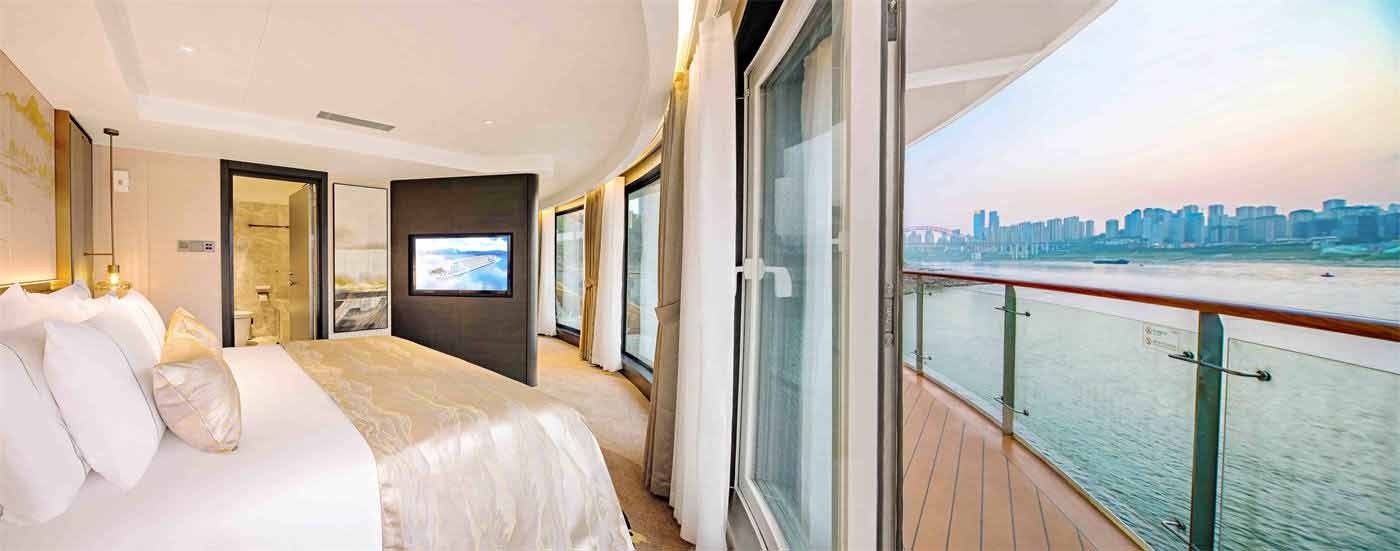
Unpacking once is not a small detail on a complex China itinerary.
China can be rewarding to tour, but it can also be demanding. A land-heavy itinerary may involve early departures, long sightseeing days, internal flights or trains, repeated check-ins, and the constant need to reorganize luggage.
A river cruise changes the pace without making the trip feel inactive. You continue moving through the destination, but your cabin remains the same. You can return from an excursion, change clothes, sit by the window or on a balcony, and watch the journey continue without another transfer.
That rhythm matters most in the middle of a longer trip. After several busy days in Beijing or Xi’an, the Yangtze can provide a reset without turning the vacation into a resort stay disconnected from the destination.
A good Yangtze itinerary is more layered than scenic sailing alone.
Travelers sometimes hear “river cruise” and picture long stretches of sitting onboard while the scenery passes. Scenic sailing is part of the appeal, but it is not the entire experience. Stronger itineraries combine time on the river with shore excursions and onboard interpretation that help explain what travelers are seeing.
The Three Gorges are visually important, but the river also carries stories about settlement, migration, commerce, infrastructure, and the scale of modern China. Excursions can provide context for communities, landscapes, engineering projects, and historic sites that would otherwise remain distant from the ship.
This balance is what keeps the cruise from feeling passive. Guests are not simply watching China from a window. They move between observation and participation: time on deck, time ashore, conversation, interpretation, and the quieter moments when the ship is underway.
The ship and itinerary still matter. Not every sailing offers the same cabin quality, excursion mix, pacing, or amount of English-language support. The broader China River Cruises page explains how current cruise and cruise-tour options can be compared.
The result is not a substitute for seeing China’s major cities. It is a different layer of the trip, and that distinction is important. The cruise is strongest when travelers understand that it is adding perspective and rhythm—not replacing every other part of China.
The Yangtze is not a Rhine or Danube cruise transplanted to China.
Travelers familiar with European river cruising sometimes approach the Yangtze expecting a familiar product in a new setting. That comparison can be useful, but only to a point. The river, ports, ships, service style, surrounding infrastructure, and cultural context are different.
That difference is not a weakness. It is the reason to go. A Yangtze cruise should feel connected to China, not like an imitation of Europe. Travelers who embrace the destination on its own terms are more likely to find the experience rewarding than those measuring every meal, cabin detail, or excursion against the Rhine.
It is also important to be honest about pace. The Yangtze works best for travelers who enjoy scenery, reflection, and a trip that allows moments of quiet. Someone seeking constant nightlife, nonstop entertainment, or a new marquee landmark every few hours may feel the cruise is too restrained.
In that case, a broader China cruise tour may be the better answer. The river can still be included, but as one part of a faster, more comprehensive itinerary.
The cruise is most worthwhile when it solves a real travel problem.
For some travelers, the problem is pace. They want to see more of China but do not want every day to be built around a new hotel and another long transfer. For others, the problem is perspective. They do not want their first China trip to feel like a collection of airports and famous city landmarks.
The Yangtze addresses both. It allows travelers to continue exploring while reducing the number of logistical decisions they need to make each day. It also creates a sense of place that is difficult to achieve through a series of disconnected land stops.
The experience tends to fit travelers who appreciate scenery, history, and the idea that a meaningful day does not have to be a rushed day. It can work well for couples, solo travelers, experienced cruisers looking for something different, and travelers building a once-in-a-lifetime China itinerary around a mixture of major cities and slower regional travel.
Timing also affects the value. Weather, scenery, river conditions, crowds, and the land portion of the trip can all shape the experience. The best time to take a Yangtze River cruise should be considered alongside the cities you plan to visit before or after the sailing.
When might it not be worth it?
The cruise may be harder to justify when a traveler has very limited time and a long list of city-based priorities. Someone with only a week in China may prefer to focus on one or two major regions rather than divide the trip too aggressively.
It may also be the wrong fit for someone who sees onboard time as wasted time. The river journey depends on appreciating the space between excursions. If every hour needs to be filled with a major attraction, the experience may feel slower than expected.
So, is a Yangtze River cruise worth it?
Yes, when the cruise is chosen for the experience it actually provides. It is worth it for travelers who want to see inland China from a perspective that cannot be recreated by a flight or motorcoach. It is worth it for travelers who value the comfort of unpacking once but still want the trip to keep moving. And it is worth it for travelers who understand that the quieter parts of a journey can sometimes become the most memorable.
It is not automatically worth adding simply because it is famous, and it should not be treated as a required box to check. The right question is not whether the Yangtze belongs on every China itinerary. It is whether the river adds something your version of the trip would otherwise be missing.
For the right traveler, it does. The Yangtze can become the part of the journey that slows everything down just enough to make China feel larger, more connected, and more memorable.
Related China river cruise guides
Ready to decide how the Yangtze fits into your China journey?
Beyond the Castle Travel can help compare the river itinerary, ship, cabin, season, and land arrangements around the way you want to travel.
Explore China River Cruises