
What Is a Quark Expeditions Voyage Really Like? Ships, Landings & What to Expect
A Quark Expeditions voyage is not a conventional cruise with a fixed sequence of ports. It is a flexible polar journey in which weather, ice, wildlife and safety shape what happens each day.
Guests still return to a comfortable ship for meals, warm cabins and lectures, but the reason to go is what happens beyond it: Zodiac cruising, shore landings, wildlife encounters, changing ice and the chance to learn from specialists who spend their careers in the polar regions.
I have completed Quark’s Polar Pro advisor training, but this article is not presented as a firsthand passenger review. It is a practical explanation of how Quark’s current ships, expedition teams and activity model work—and what travelers should compare before choosing a voyage.
What is a Quark Expeditions voyage really like?
Expect a small expedition ship, an expert-led daily program, Zodiac operations and a schedule that can change at short notice. Some days may include a landing and a Zodiac cruise; others may feature wildlife viewing, presentations, science programming or a revised plan because conditions make the original idea unsafe or less rewarding.
There is a plan—but it is not a promise.
Expedition teams study weather, ice, sea state, wildlife activity and local operating rules before deciding how the day should unfold. Guests normally receive an evening briefing and a proposed plan for the next day, followed by updates if conditions change.
That flexibility is not a sign that the itinerary is poorly organized. It is part of responsible polar travel. A landing can be delayed because of wind, replaced by Zodiac cruising, or moved when wildlife or ice creates a better opportunity elsewhere.
The most important mindset: book the region and expedition style, not one promised photograph. Wildlife, sea ice and individual landing sites can never be guaranteed.
What might a day include?
- An early wildlife or landscape announcement from the bridge
- A Zodiac cruise among ice, cliffs or marine wildlife
- A shore landing with marked walking routes
- Presentations on biology, glaciology, history or photography
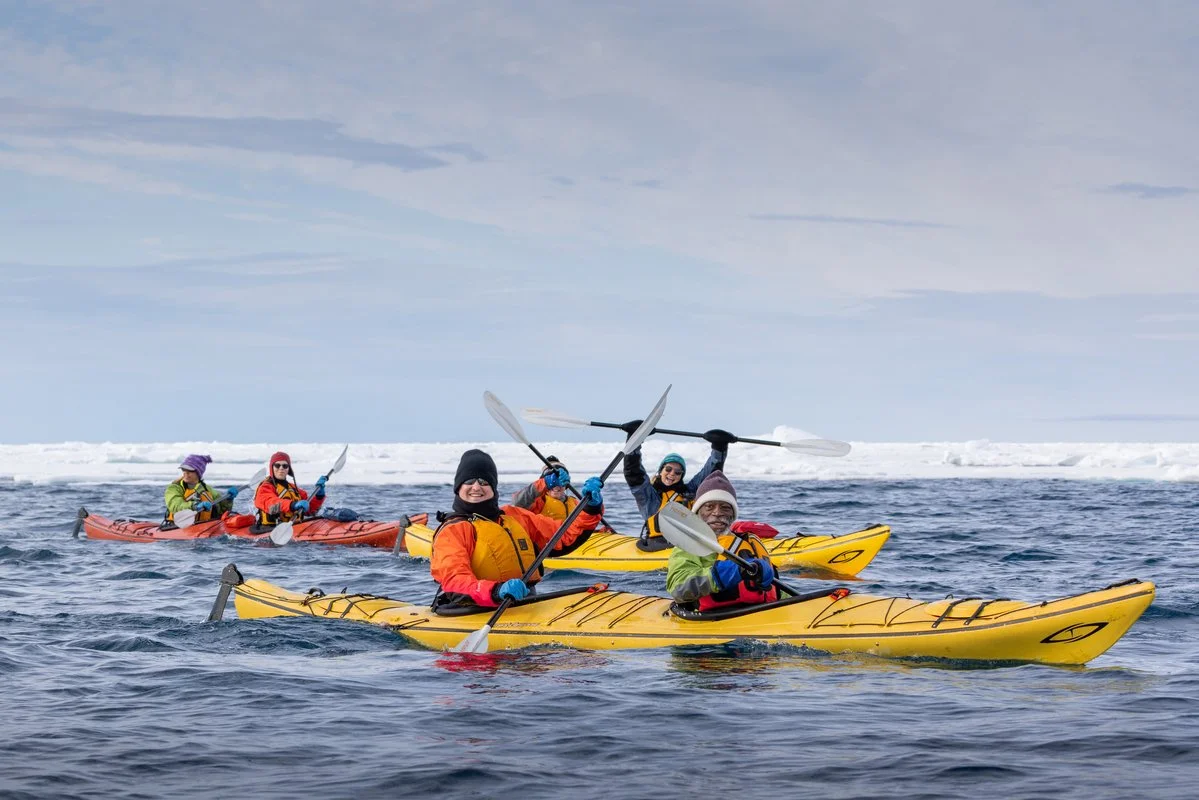
- An optional activity such as kayaking, paddling or camping
- A recap explaining what guests observed and what may happen next
Ultramarine, Ocean Explorer and World Voyager create different trips.
Quark currently operates three ships carrying fewer than 200 guests. The shared focus is polar exploration, but ship capacity, cabin design, observation areas and specialized equipment differ enough to affect the experience.
| Ship | Guests | Standout feature | What to consider |
|---|---|---|---|
| Ultramarine | 199 | Two twin-engine helicopters, 20 Zodiacs and a broad adventure-activity platform | Helicopter operations are itinerary- and condition-dependent and do not operate on Quark’s Svalbard and Spitsbergen voyages |
| Ocean Explorer | 138 | Quark’s smallest current ship, with an X-Bow, two-story library and 15 Zodiacs | Strong fit for travelers prioritizing a lower guest count and modern Scandinavian-style accommodations |
| World Voyager | 168 | Science Hub, 18 Zodiacs, all-balcony-style accommodations and Antarctic-focused programming | Infinity Suites use a Juliet-style opening rather than a traditional walk-out balcony |
The earlier version of this article referenced World Explorer. Quark’s current fleet now lists World Voyager instead. Travelers should compare the live departure page because ships, activities and itinerary assignments can change by season.
Zodiac cruising and shore landings are the center of the voyage.
Zodiacs are rigid inflatable boats used to move guests between the ship and shore, cruise near ice and wildlife, and explore places that do not have conventional ports. Boarding normally involves stairs, a platform near water level and crew assistance.
Antarctic landings follow IAATO operating rules. No more than 100 visitors may be ashore at one site at one time, so ships carrying more than 100 guests may divide the group between a landing, Zodiac cruising or another activity before rotating.
A landing is not a normal shore excursion.
- There may be no dock, pavement, vehicle or indoor facility
- Guests may step into shallow water during a wet landing
- Walking surfaces can include snow, rock, mud, ice and uneven ground
- Wildlife distance and biosecurity instructions are mandatory
- The landing can be shortened, moved or canceled when conditions require it
Travelers do not have to participate in every activity. Staying aboard can still provide observation, lectures and scenery, but someone planning to skip most Zodiac outings should consider whether an expedition fare is the right use of the travel budget.
The expedition team changes what guests understand.
Quark’s teams can include expedition leaders, marine biologists, ornithologists, geologists, glaciologists, historians, photography guides and activity specialists. The exact mix varies by voyage, so a particular expert or specialty should not be assumed unless it appears in the departure information.
Their role extends beyond lectures. Team members scout sites, drive Zodiacs, guide walking routes, monitor wildlife behavior, explain biosecurity and help travelers connect what they see outside with the science, history and conservation issues behind it.
Science and Discovery
Quark’s current Science & Discovery program says observational citizen science is available on all Arctic and Antarctic departures. Activities may include seabird surveys or reporting whale photographs. More interactive data collection and researcher-led programming appears only on selected voyages and remains subject to conditions.
Antarctica and the Arctic are not interchangeable.
Quark generally operates in Antarctica from November through March and in the Arctic from May through September. Those broad windows do not explain the full experience: early Antarctic snow, penguin nesting, whale activity, Arctic sea ice, midnight sun and regional community visits all change by route and month.
| Region | Typical Quark season | Common priorities | Important planning factor |
|---|---|---|---|
| Antarctica | November through March | Penguins, enormous ice, Zodiac landings, whales and the Antarctic Peninsula | Most classic voyages cross the Drake Passage; longer routes may add South Georgia and the Falklands |
| Svalbard | Arctic summer | Sea ice, polar-bear search, walruses, seabirds and dramatic fjords | Wildlife searching can involve long observation periods and no sighting is guaranteed |
| Greenland & Arctic Canada | Arctic summer into early fall | Fjords, icebergs, tundra, communities, culture and wildlife | Flights, remote embarkation points and community-sensitive itineraries require careful logistics |
| Snow Hill Island | Specialized Antarctic window | Emperor penguins and helicopter-supported access attempts | One of Quark’s most conditions-dependent and specialized programs |

Start with our Antarctica vs. the Arctic comparison when deciding between the poles. Travelers already focused on the south can use the Antarctica month-by-month guide and South Georgia comparison to narrow the route.
IAATO and AECO set standards—but they are not governments.
The original article described IAATO and AECO as organizations that regulate polar tourism. A more accurate explanation is that they are membership associations that develop operating standards, visitor guidance and industry procedures. Antarctic tourism also operates within the Antarctic Treaty system and national authorization processes, while Arctic rules vary among sovereign countries and territories.
Quark is a current IAATO member for Antarctic operations and a full AECO member for Arctic expedition cruising. Guests can expect mandatory briefings, wildlife-distance guidance, boot and clothing decontamination, site-specific instructions and the possibility that a landing will be abandoned to protect wildlife or comply with current health protocols.
Travelers can review the IAATO visitor-preparation guidance before departure. Beyond the Castle Travel also explains its broader approach on the Responsible Travel page.
Curiosity matters more than being an extreme adventurer.
A Quark voyage can fit photographers, wildlife travelers, solo guests, active retirees and first-time polar explorers. The strongest candidates are comfortable with changing plans and understand that remote access matters more than entertainment schedules.
A Quark expedition may fit you if:
- You want a company focused specifically on the polar regions
- You value wildlife, landscapes and expert interpretation
- You are comfortable with Zodiac boats and uneven terrain
- You accept that the daily plan can change
- You want optional adventure activities on selected departures
Another travel style may fit better if:
- You need a guaranteed daily itinerary
- You primarily want nightlife, shows or resort-style ship attractions
- You are unwilling or unable to use small boats on the selected voyage
- You would be deeply disappointed by missed wildlife or a changed landing
- You want a warm-weather vacation centered on relaxation
The broader What Is an Expedition Cruise? guide explains how this travel style differs from a traditional cruise. The Expedition Cruises planning page compares Quark with other expedition operators rather than assuming one brand fits everyone.
Compare the complete expedition—not only the ship name.
- Route length and the number of open-water crossing days
- Ship capacity, cabin location and balcony configuration
- Landing rotations and Zodiac-boarding arrangements
- Included parkas, boots, hotels, transfers and charter flights
- Optional activity availability and physical requirements
- Deposit, cancellation, medical and insurance requirements
- Solo pricing and limited dedicated single cabins
- Pre-expedition weather buffers and international flight planning
Polar Pro training is useful, but it should not predetermine the recommendation. The right answer may be Quark, another expedition line or a different route entirely. Ship size, activity level, comfort, wildlife goals and complete-trip logistics should lead the decision.
Related expedition-cruise guides
Quark Expeditions FAQ
A Quark voyage is a small-ship polar expedition built around Zodiac outings, shore landings, wildlife viewing, expert interpretation and a flexible daily plan. Weather, ice, sea conditions and wildlife can change the schedule.
Quark’s current fleet consists of Ultramarine, Ocean Explorer and World Voyager. The ships carry 199, 138 and 168 guests respectively, according to Quark’s current ship pages.
No. Ultramarine carries two twin-engine helicopters, but helicopter-supported activities depend on the itinerary, conditions and published inclusions. Quark specifically notes that the helicopters do not operate on its Svalbard and Spitsbergen voyages.
IAATO operating rules limit landing vessels to no more than 100 visitors ashore at one site at a time. Because Quark’s ships carry more than 100 guests, expedition teams may use rotations between shore landings, Zodiac cruising and other activities.
Quark generally operates Antarctic expeditions from November through March and Arctic expeditions from May through September. The best month depends on the route, wildlife priorities, ice conditions and available daylight.
Quark states that observational citizen-science programming is available on all Arctic and Antarctic departures. More interactive programs operate on selected departures and remain subject to weather, staffing and voyage conditions.
You do not need to be an extreme athlete, but you should be comfortable stepping into Zodiac boats, using stairs and walking on uneven, wet, snowy or rocky surfaces. Optional kayaking, longer hikes and camping may require additional mobility.
Early planning is useful for limited cabin categories, solo space, specialty routes and optional activities with restricted capacity. The correct booking window depends on the itinerary and season rather than one universal deadline.
Ready to explore a Quark expedition—or compare it with another polar line?
Beyond the Castle Travel can help compare the ship, route, cabin, landing model, activity space, included logistics and complete trip cost. Expedition-cruise planning is fee-free.