
Is South Georgia Worth It? Why So Many Expedition Guides Call It Their Favorite Place on Earth
Expedition Cruise Planning
When we asked expedition guides about their favorite place in the polar regions, South Georgia came up again and again.
That answer surprises many travelers because most begin planning with Antarctica as the main goal and know very little about South Georgia. The island sits far out in the South Atlantic and is known for enormous king penguin colonies, elephant seals, rugged mountain scenery, and its connection to Ernest Shackleton.
Adding South Georgia and the Falkland Islands usually means more days at sea, a longer trip, and a higher price. It also creates a very different expedition from a classic Antarctic Peninsula voyage.
The right choice depends on what you most want to see, how much time you have, and whether the added wildlife and history are worth the extra travel days.
What South Georgia actually is
South Georgia is a remote, mountainous island in the South Atlantic, about 800 miles southeast of the Falkland Islands. It has no permanent residents, although small teams of government officers, researchers, and seasonal museum staff live there for parts or all of the year.
There is no airport or runway. Visitors arrive by ship, sleep onboard, and use the vessel as their base for Zodiac landings and exploration.
Reaching South Georgia usually requires several days at sea, depending on whether the itinerary approaches from the Falklands, Ushuaia, or the Antarctic Peninsula. The time and distance are part of the reason it remains so wild.
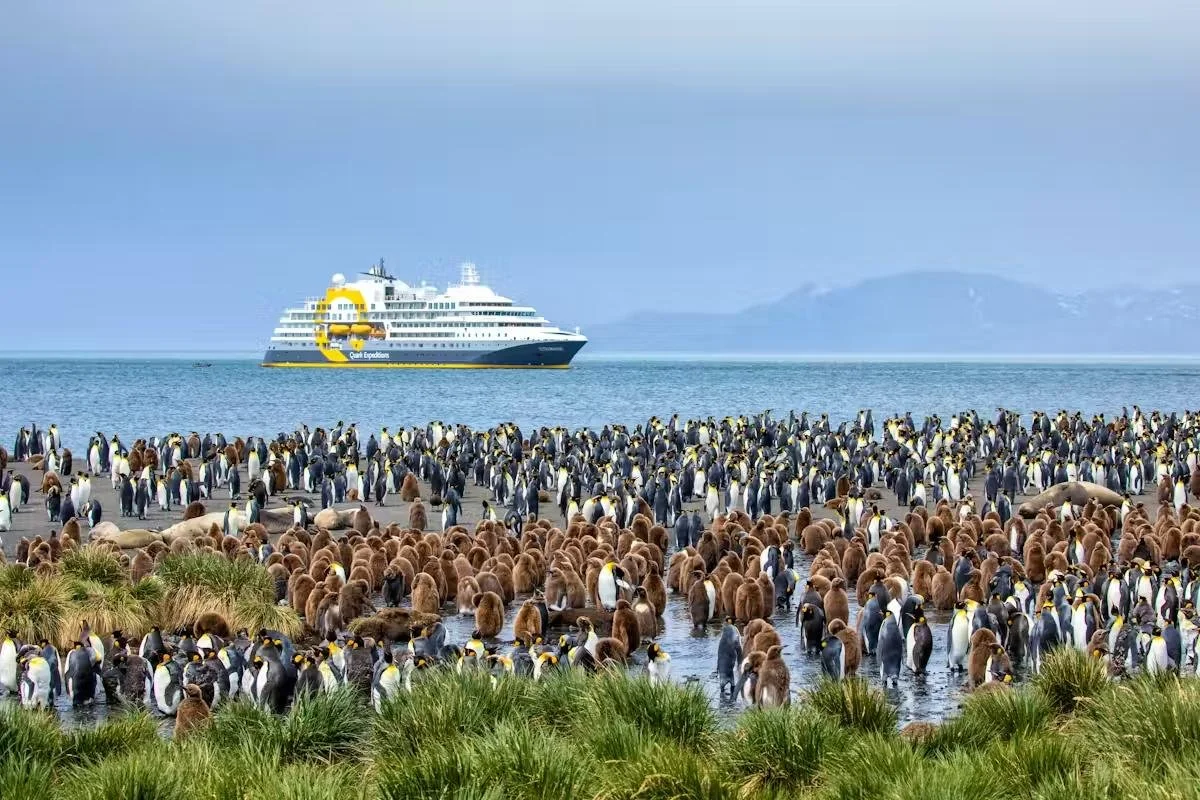
Glaciers pour from a spine of mountains that rises sharply from the ocean. The beaches below hold some of the greatest concentrations of penguins, seals, and seabirds anywhere on Earth.
That is the reason expedition guides talk about the island with so much emotion.
The wildlife is on a different scale
The Antarctic Peninsula can deliver remarkable penguin colonies, but South Georgia changes the scale.
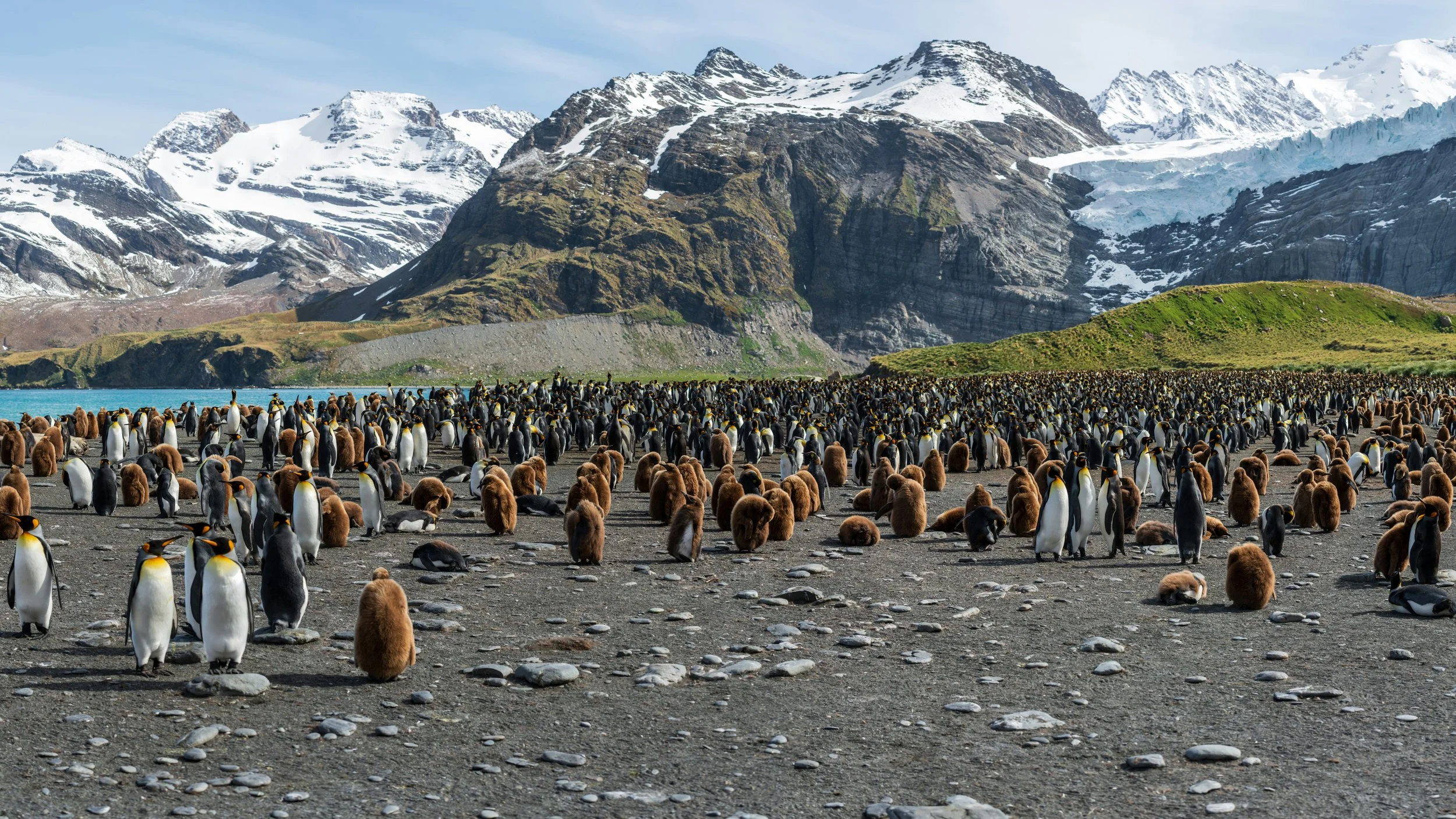
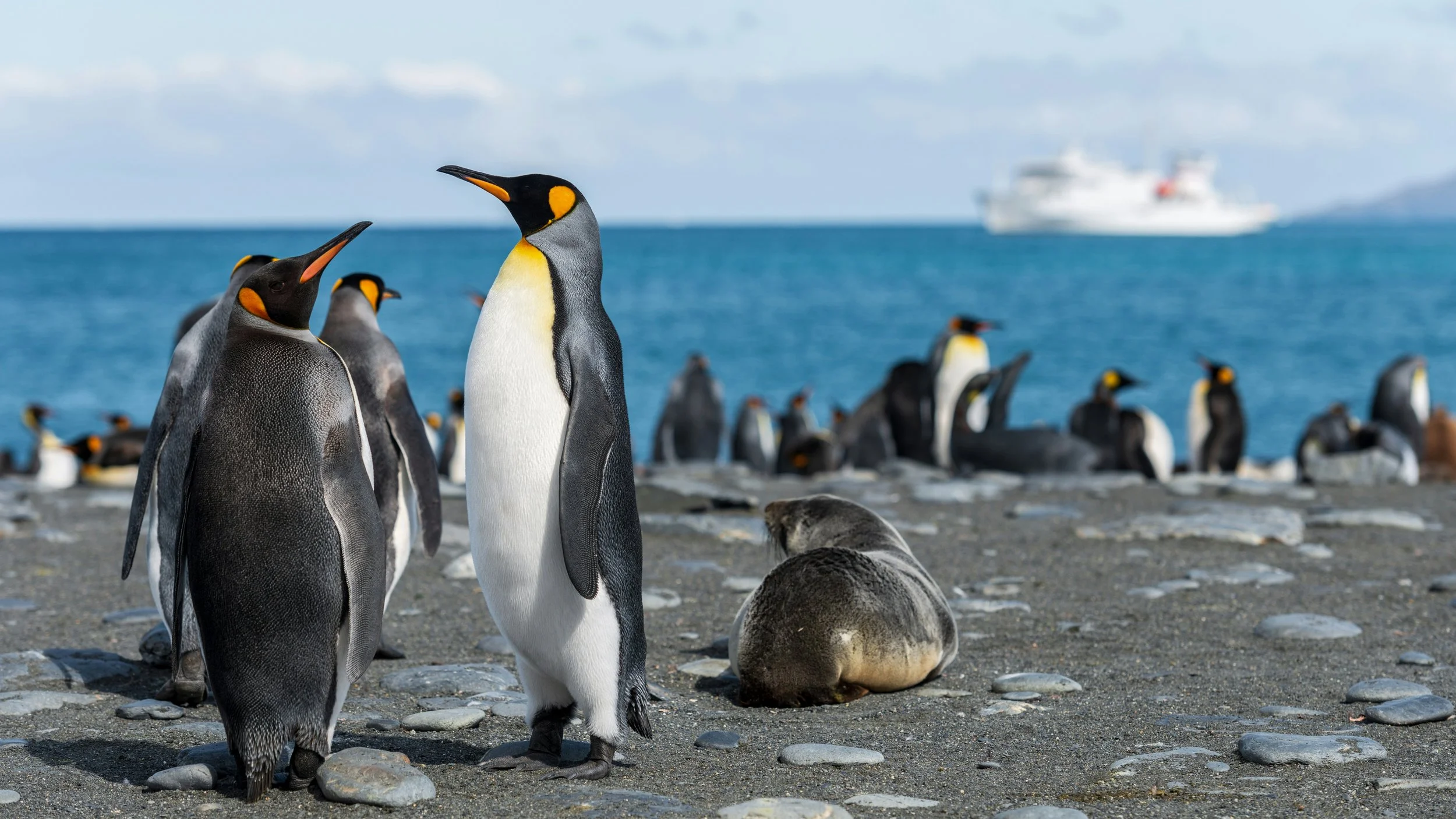
At sites such as St. Andrews Bay and Salisbury Plain, king penguins can cover the landscape as far as you can see. The tall, orange-marked birds stand among brown chicks, Antarctic fur seals, southern elephant seals, and clouds of seabirds, with glaciers and mountains behind them.
It is difficult to understand the size of the scene from a photograph. The sound, movement, smell, and sheer number of animals make it feel less like visiting a colony and more like stepping into the middle of a functioning wildlife city.
South Georgia also supports globally important populations of seabirds and marine mammals. Wandering albatrosses, which have the greatest wingspan of any living bird, nest in the region. Elephant seals and fur seals crowd certain beaches during the breeding season, and the exact wildlife mix changes throughout the austral summer.
Unlike searching a vast landscape for one elusive animal, the great colony sites are known. Access, however, is still controlled by weather, surf, wildlife conditions, conservation rules, and the expedition team's judgment. Nothing in polar travel is guaranteed simply because it appears on the itinerary.
The history makes the island even more powerful
Wildlife alone could justify the journey. What makes South Georgia unforgettable is that it layers one of exploration's greatest survival stories on top of it.
After the Endurance was crushed by ice, Ernest Shackleton and five companions sailed roughly 800 miles from Elephant Island to South Georgia in the small James Caird. Shackleton, Frank Worsley, and Tom Crean then crossed the island's unmapped mountains and glaciers to reach the whaling station at Stromness and seek help.
Their efforts eventually led to the rescue of the 22 men waiting on Elephant Island. Every member of the Endurance expedition survived.
Many South Georgia itineraries visit Grytviken, the former whaling station where Shackleton is buried. Visitors often gather at his grave and toast "the Boss," a tradition that can be unexpectedly moving even for travelers who did not arrive as polar-history enthusiasts.
Standing at Grytviken, surrounded by the mountains of the island Shackleton crossed, turns the story from something you read into something connected to a real landscape.
Some voyages may also visit sites associated with the James Caird landing or offer walks connected to the Shackleton story when conditions and permits allow. As with every South Georgia landing, the final plan belongs to the weather and the expedition team.
The honest trade-offs
South Georgia itineraries ask more of the traveler, and it would be dishonest to pretend otherwise.
A classic Antarctic Peninsula voyage often runs roughly 10 to 12 days. A combined voyage including South Georgia and the Falkland Islands may run 18 to 23 days or longer, depending on the route.
The price rises with the additional nights, and the sea days are real. Travelers who are concerned about motion should consider ship design, stabilizers, cabin location, medication, and the amount of open-water sailing before making a deposit.
Landings on South Georgia are also weather-dependent. The island is known for strong winds, changing surf, and conditions that can force an expedition team to rearrange or cancel a planned landing.
There is another trade-off that surprises people. Because these itineraries combine South Georgia, the Falklands, and Antarctica, some may spend fewer days along the Antarctic Peninsula than a dedicated Peninsula voyage.
That does not make the longer trip worse. It means the traveler is exchanging some Peninsula time for a broader expedition.
If setting foot on the seventh continent and maximizing time around the Peninsula are the only priorities, a Peninsula-focused itinerary may be the better choice. We would rather tell a traveler that honestly than assume the more expensive voyage is automatically superior.
So, is South Georgia worth it?
For travelers who care most about large wildlife colonies, polar history, and remote scenery, South Georgia can justify the additional time and cost. The king penguin colonies alone are on a scale that most Antarctic Peninsula itineraries do not match, and the Shackleton sites add another layer to the trip.
A classic Peninsula voyage may still be the better choice for someone with a shorter vacation window, a tighter budget, or a strong preference for spending as much time as possible in Antarctica itself. Choosing that route does not mean accepting a lesser expedition. It simply prioritizes a different part of the region.
The most useful comparison is not whether one itinerary is universally better. It is how many days each voyage plans in Antarctica, South Georgia, the Falklands, and at sea, along with the wildlife timing, ship, cabin, and total trip cost.
If you are deciding between a Peninsula voyage and a longer South Georgia and Falklands itinerary, Beyond the Castle Travel can compare the options against your dates, budget, wildlife priorities, comfort level, and available time.
Compare the full journey
Peninsula only or South Georgia and the Falklands?
We will compare the ships, routes, sea days, landing plans, wildlife timing, cabin options, and complete trip costs so you can choose the expedition that fits your priorities.
Start Planning Your ExpeditionDouble-click to edit...